Statements
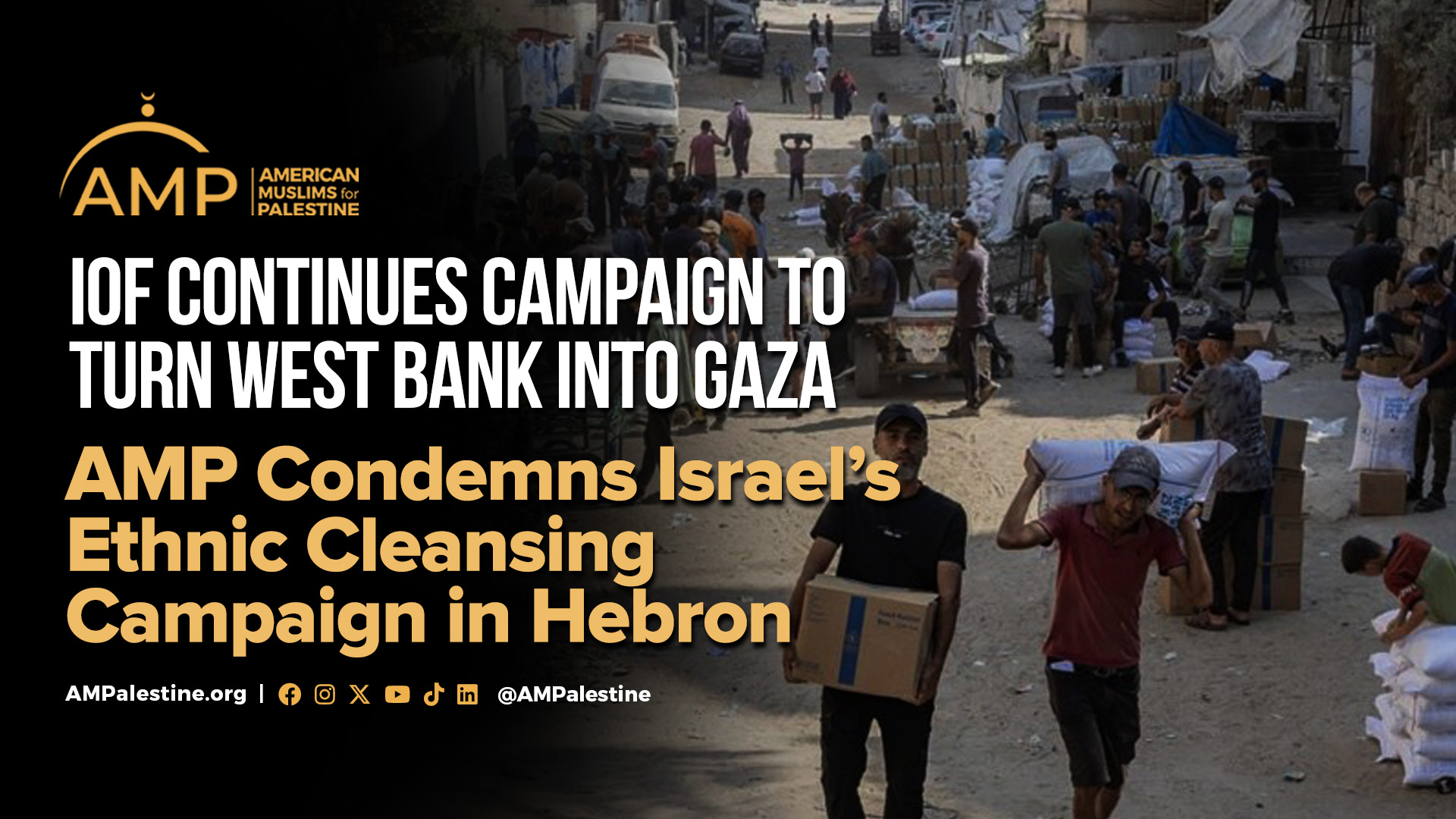
American Muslims for Palestine (AMP) condemns Israeli occupation forces (IOF) ethnic cleansing campaign in the occupied Palestinian city of Hebron...

Today, May 15th, marks 78 years since the climax of Israel’s mass expulsion and ethnic cleansing campaign in Palestine, known as the Nakba. The Nakba was not a singular event, but the climax of a process of colonization that began in 1882. For decades, the destruction of Palestinian life and society has been known to the world, but it has been more acutely felt by Palestinians themselves, still yearning to drink from the well of justice while facing annihilation. Every weapon of war and tactic of extermination has been deployed against the Palestinian people, culminating in the Gaza genocide we are witnessing today.
Israel has entrenched its apartheid system through decades of criminal practices against the Palestinian people. From military rule in 1948 Palestine from 1948-1966, to a brutal military occupation of the remainder of historic Palestine (i.e., West Bank & Gaza Strip) since 1967, and the dispossession of 750,000 in 1948 and another 300,000 in 1967, Israel’s oppressive system knows no bounds. Between 1948 and 1967, and long after, Israel committed atrocities and massacres against the Palestinian both inside historic Palestine and beyond. Among these were the massacres of Deir Yassin and Tantura in 1948, Kafr Qasim and Khan Yunis in 1956; the Tel al Zaatar massacre in 1976; the Sabra and Shatila massacres in Lebanon in 1983; the Al-Aqsa massacre in 1990; the Ibrahimi Mosque massacre in Hebron (Al-Khalil) in 1994; the Jenin refugee camp massacre in 2002, and many others.
Israel’s ongoing campaign does not end in the Middle East. Even in the United States itself, Palestinian activists and those who stand in solidarity with Palestinians are targeted. From Salah Sarsour, Mahmoud Khalil, Mohsen Mahdawi, Leqaa Kordia, Rumeysa Ozturk, Badar KhanSuri, and Ya’kub Vijandrew are but a few examples of Zionist repression— and of Palestinian steadfastness and resilience. However, as global popular sympathy for Palestine and the Palestinians grows— especially in the United States— Zionist repression and violence against the Palestinian people intensifies. Yet, Israeli brutality only strengthens Palestinians’ demand for their rights and drags Israel’s image deeper into the abyss of disgrace.
Palestinians insist on remaining. Remaining in their land, remaining in the world, and remaining as a thorn in the side of those who believe that the Palestinians can be destroyed once and for all. Palestinians inherit the trauma, stories, and consequences of the devastation leveled against their people from decades past. However, they refuse to accept any of it as a normal condition of being. It is precisely this refusal that angers those who are determined to erase Palestinians wherever they may be in the world. The Nakba–like the cluster bombs Israel uses–spreads its devastation through time and space. The initial munition is deadly on its own, but the smaller bomblets spread to a wider area. Some explode immediately on impact, while others remain unexploded only to kill later, long after the initial shock. This is meant, as we see today, to create a dark reality whereby Palestinian life is constantly devalued and diminished.
Ironically, the Convention on the Prevention and Punishment of the Crime of Genocide (the Genocide Convention) was codified in international law in 1948 as the Nakba was underway. As the text of the Genocide Convention was being written, Zionist terror gangs recently formed into the Israel Defence Forces, committed at least two massacres in the first week of November 1948, killing dozens of Palestinians and forcibly displacing hundreds more from the villages of Arab al-Mawasi (Tiberias) and Majd Al-Kurum (Galilee). By the time the final text of the convention was adopted in December 1948, the nascent State of Israel had nearly completed the first phase of its ethnic cleansing campaign in Palestine. This was a clear sign that, as the world moved to identify, define, and prevent genocide, Israel was still sharpening its tools of genocidal machinery.
We write this statement, as Dr. Hatem Bazian states, not simply to remember, but to insist that “the right of return is a living demand, not a closed historical claim.” It is precisely this insistence on the rights of the Palestinian people that animates our work at American Muslims for Palestine, for it is this insistence that allows us to imagine the possibilities of the future and to continue despite the challenges we face.
We continue to commemorate the Nakba. Please join our chapters across the country to stand with Palestine and the Palestinian people: